Raise your hand if you love long commutes? ✋
Anyone? Bueller? Bueller?

Well, here’s some good news for long-commute-lovers (and bad news for the rest of us): Long commutes are back across Greater Boston — and for many people, they’re worse than ever.
Flexible working reimagines a reality where people don’t have to make compromises between work and life. What does this approach mean for professionals in Greater Boston?
The real cost of long commutes in Boston
Some are driving from Rhode Island or southern New Hampshire; others are piecing together multi-leg trips combining buses, commuter rail, and the T. To top it off, Boston's traffic is among the worst in the nation.
Commutes are a compromise between where you work and where you live, and how long you’re willing to travel. For many, that compromise is incurring costs in the form of burnout, stress, wasted time, rest, mental health, and connection with friends and family.
Why people are living farther from Boston, and not coming back
Many New England professionals now spend 2–3 hours per day just getting to and from Boston, and the commute is stretching them thin. So why do they do it? It’s certainly not because they love sitting in traffic.

Most likely, professionals with long commutes moved away from the city because:
- Housing prices near Boston are out of reach
- Families need more space
- The schools fit their family needs
- They have caregiving responsibilities
- They’re in dual-career households that juggle multiple locations
- Remote options made distance feel possible before they got the return-to-office mandate
Boston jobs stayed in Boston, but Boston workers haven’t. They’re just as educated, just as qualified, and just as talented — but they’re living farther away.
This is where flexible and hybrid work are reshaping the future of work.
Hybrid work changed expectations, but infrastructure didn’t
When the world went remote in 2020, businesses and professionals had to quickly adapt to a new normal. While many teams have returned to the office, others have discovered it’s not as simple as opening the office doors again.
In 2025, 39.8% of U.S. workers reported working alone — that’s down from the previous year. At the same time, 30.5% reported they are working with others in person.
But people aren’t moving back to urban centers just because their job wants butts in seats. They’re demanding hybrid work options that fit their lifestyle, which then require flexible workspaces. No wonder the demand for flexible workspaces is growing nationwide.
The answer for many professionals has become regional coworking and flexible office space near home. Instead of one HQ that’s centrally located (and inconvenient to a majority of employees), teams are choosing multiple convenient locations. 26% of companies that use flexible office spaces say that “offering[ing] employees more choice of where to work” is a top motivation.
.png?width=1200&height=600&name=Source%20CBRE%20Research%2c%20Spring%202023%20U.S.%20Occupier%20Sentiment%20Survey%2c%20April%202023.%20(1).png)
Why people prefer Boston coworking and flexible office spaces
This is where things get interesting. People want flexible workspaces, but that doesn’t necessarily mean they want to work from home (or the local coffee shop) every day.
What people actually want from hybrid work:
- A professional workspace in a convenient location
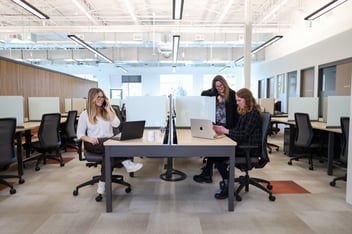
- Amenities like ergonomic furniture and bookable conference rooms
- Options that work with their lifestyles
Kitchen tables, cushy couches, and busy third places get old fast. They might be convenient, but they’re not always conducive to productive work.
Final takeaway
If history’s anything to go by, it’s safe to say that Boston’s commute isn’t getting shorter anytime soon. But workdays can — with smarter access to workspaces that work for more professionals.
At Workbar, we see professionals seeking to fulfill these needs every day across Greater Boston and New England. That’s why we’re committed to providing intentionally designed spaces in easy-to-reach locations such as:
- Needham
- Woburn
- Cambridge
- Quincy
- Salem / North Shore
- Worcester
- Framingham / MetroWest
- and more coming online
Are you ready to stop sacrificing hours to the Pike or 93? Book a tour at one of our eleven Workbar locations.