Boston Saw This Coming: Making Work Work, CEO Series Vol. 10

How Boston’s coworking model helped shape the future of flexible workspace.
About 20% of Workbar members work from locations other than their home base in a given week, and the number of members doing so has grown roughly 25% over the past year. After 15 years of operating coworking spaces in Boston, we study patterns like this to see how people actually work.
They don’t want one desk. They want the right place to work depending on the day.
Closer to home one day.
Closer to meetings the next.
Somewhere quieter when they need focus.
Somewhere more social when they want energy.
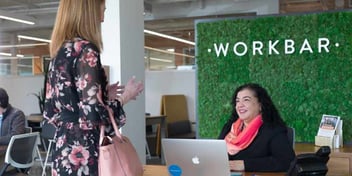
When Workbar was launched in 2009, we didn’t begin with a theory about the future of work. We began by simply watching what people did inside an open space. People naturally moved throughout the day. Phone calls naturally gravitated to one area. Collaboration and brainstorming happened somewhere else, separated from where people were doing heads-down work. And there was always a gathering place where people could socialize. No one stayed at the same desk all day.
So instead of forcing people into a static environment, we designed the space around that behavior. Different neighborhoods for different types of work. Open areas with energy. Quiet areas for focus. Spaces meant for conversation.
Over time, something else became obvious: people didn’t just move around within the space. They wanted the option to work closer to where their life was happening. Keeping the tradition of watching how our members worked and listening to what would help them be more productive, we slowly started to build locations in the suburbs that eventually created a network of space across Greater Boston. Members could work near home, near meetings, or near their kid’s school if they were on carpool duty (wink wink).
Boston has always been a place where new ideas take root early.
As Scott Kirsner told us on our podcast Setting the Bar, the first coworking space in the world might have actually been right here in Boston—where Alexander Graham Bell and Thomas Watson worked side by side when they invented the telephone and made the first phone call. Boston is a dense ecosystem of universities, startups, venture capital, established companies, and independent professionals constantly pushing the boundaries of how they work, find talent, and make connections. This environment naturally lends itself to flexible workspaces and coworking spaces, places where people can connect, collaborate, and focus without being tied to a single office.
As I’ve talked about before, the entire office asset class was built around how people had to work before modern technology. The math was simple: 1 person = 1 desk, or about 250 square feet. That formula made planning easy for decades. Disruption, however, is hard.
One of the challenges today is that many people still think of coworking spaces as one monolithic category. Recently I saw a post on LinkedIn from someone who has a private office at another coworking provider. He described traveling for a few days, coming back to his office, and finding his belongings moved around. There were crumbs on his desk. Someone else had been using the space. This happened 4 times in one year.
His experience surprised me for a lot of reasons but what stood out to me most was the reaction in the comments. So many people lumped all coworking companies together, saying things like: “There’s no privacy in coworking.” That’s like saying the experience is the same at a roadside motel as it is at the Four Seasons.
The category may be the same, but the experience can be completely different depending on who is running it and how thoughtfully it’s designed. Interestingly, this same person ended up touring Workbar. After spending some time in the space, he told me he had immediate trust in the environment after seeing how the space was laid out and how the community engaged with each other. He had been at WeWork for a year and didn’t have a single loose social tie to another person on his floor.
Not one.
The interesting part is that he currently pays less for a private office at that coworking company than he would for a dedicated desk in our open coworking space. And yet he’s trying to figure out how to get out of his lease so he can come to Workbar.
People want spaces where they feel comfortable, where they trust the environment, and where they feel some connection to the people around them. When those ingredients are right, work feels different.
Energy changes.
Productivity improves.
Conversations happen that wouldn’t have happened otherwise.
Boston is a city full of people trying to build things.
Researchers.
Founders.
Operators.
Students.
Professionals pushing ideas forward every day.
Those kinds of communities thrive when they have places where ideas collide and relationships form naturally. That’s why doubling down on Boston continues to matter so much to us.
Workbar was born here. We learned how people work here. And this city continues to shape how we think about the future of flexible workspace. Fifteen years later, much of the industry is still catching up to what we saw happening inside our very first space.
The best workspace design doesn’t start with a floor plan.
It starts with watching how people naturally work, then building an environment that supports it. Boston taught us that lesson early. And it’s still shaping how we make work work today.