Coworking Space vs. Private Office: Room to Grow
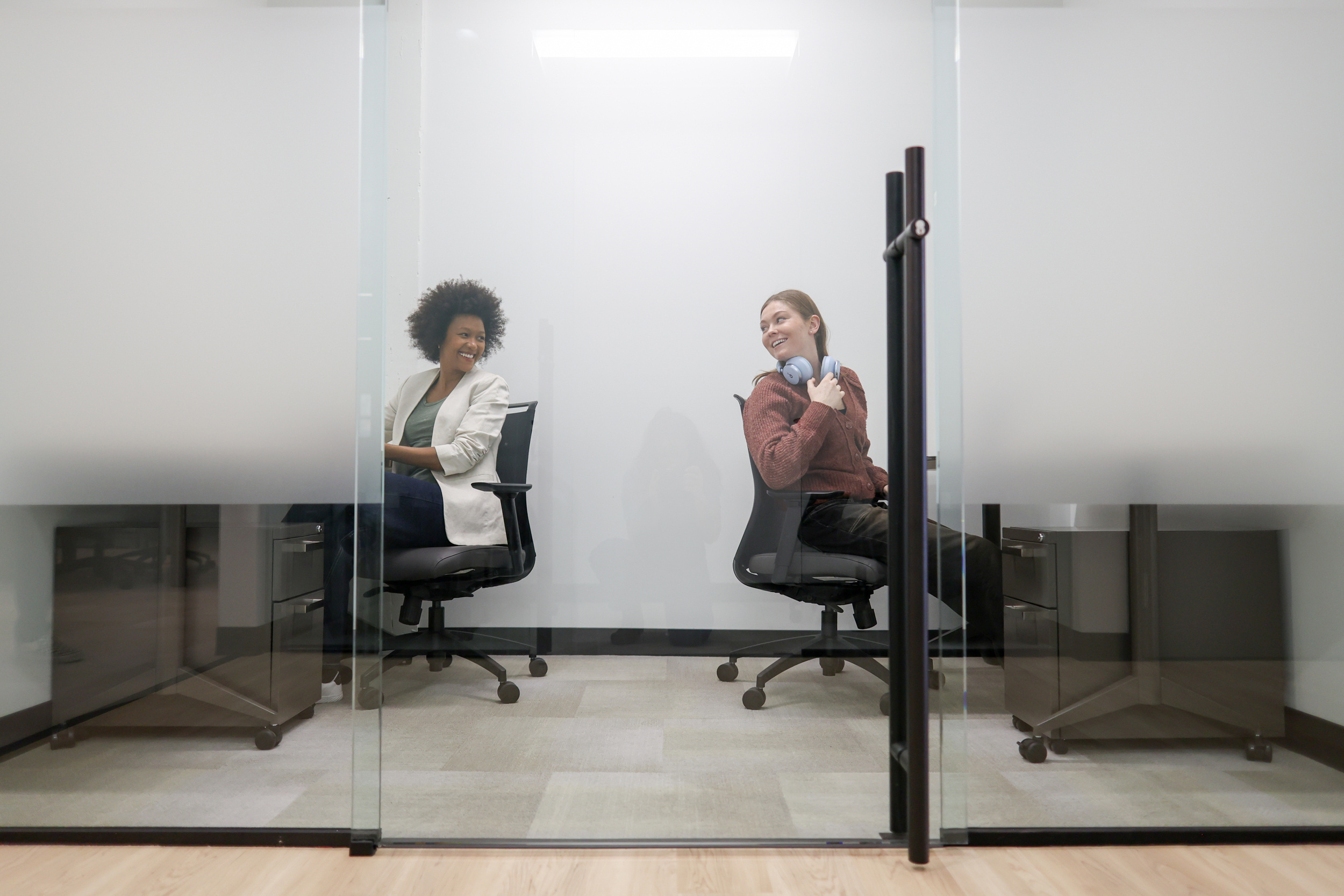
If you’re debating whether coworking or a private office is right for you or your team, we’re here to help narrow down your options. Growth doesn’t have to be so black and white—more often than not it calls for flexible, customizable solutions. (Hint: We offer that at Workbar.)
What is a coworking space?
A coworking space is a shared work environment where individuals (members) and teams from different companies work side-by-side—think hot desks, common areas, and amenities everyone has equal access to. It puts flexibility and community first, and square footage and privacy second.
What is a private office?
A private office is a dedicated, enclosed workspace designed for either one person or team. Private offices can be obtained through a commercial lease or (increasingly in Boston) a private suite inside of a larger office building or coworking space like Workbar.
Key differences between coworking and private office space
Privacy and noise levels
Coworking spaces are shared spaces, which means shared noise, too—at least in some areas. Private offices give you walls and a door to close. That said, not all coworking is created equal: spaces like Workbar intentionally design “neighborhoods” or zones around noise level, so you can find a productive space no matter what type of work you’re doing. That’s exactly why the Boston Business Journal named Workbar the Goldilocks of Boston coworking.
Cost structure and commitment
Coworking memberships are typically month-to-month with lower upfront cost. Private offices usually mean a longer commitment, but you get space that’s all yours. Neither option is necessarily “cheaper” in that sense—it just depends on what you and your team are prioritizing.
Flexibility to scale up or down
Business moves fast. Shouldn’t your workspace do the same? Coworking makes it easy to add or drop seats as your headcount shifts within any given team.
On the other hand, traditional private offices mean locking into a long term lease and renegotiating if you outgrew it.
At Workbar, our coworking and private solutions are truly flexible. We make it easy for individuals and teams to create a workspace solution that works for you.
Team size and collaboration needs
Individual workers and smaller teams tend to be happy at a hot desk or coworking space that is designed for collaboration and open communication. Once a team starts to grow and needs to meet more regularly, securing a private office starts making a lot more sense if you’re looking to give your team a homebase to work out of. Many teams pair a private office for their core crew with coworking memberships for other team members, getting dedicated space without giving up flexibility.
Is coworking cheaper than renting a private office in Boston?
To put it plainly, yes, coworking memberships typically cost less per person than renting a private office in Boston—but that’s not to say that it’s the best deal. It all depends on what you and your team value. You could get unlimited coworking space at a cheaper cost, but if what you really need is privacy, you’re probably not going to be satisfied with the end result.
5 Signs it's time to switch from coworking to a private office
Keep in mind that none of these indicators necessarily mean you have to leave coworking behind—plenty of teams move into a private office and still cowork.
At Workbar, we see our private office members working out in our open coworking areas all the time.
1. The noise is hurting your focus
If the daily hum of an open floor plan has gone from pleasant background noise to unignorable distraction, this is for you. Some coworking spaces in Greater Boston only offer phone booths to help solve this issue. But, if that’s not cutting it, a private office might be the fix you’re looking for.
At Workbar, we not only provide phone booths, we also have a dedicated Study in our coworking spaces for heads-down focus and zero distractions. That way you can cut out the noise without having to spend more on a private office when you don’t need to.
2. You need real privacy for calls and client conversations
Sensitive negotiations, confidential client work, back-to-back Zoom calls… If your day is full of conversations that shouldn’t be overheard, that’s a strong signal it’s time to pivot into considering a private office. This matters especially for Boston’s finance, biotech, and legal professionals, where confidentiality is a legal necessity, not just a nice-to-have. We don’t all need to know the last four digits of your social, after all.
3. Your team is outgrowing hot desks
We all know that team that thinks of themselves as a little “work family,” but what happens when your family becomes too big for one booth? That’s a surefire signal that your team needs its own dedicated space.
4. You want space that reflects your company culture and brand
Shared workplace environments are, by design, shared. If you’re craving a space that feels unmistakably like you—or at least, your team—that’s a private office perk. Building a strong brand identity isn’t just for external awareness. It sets the tone for your team from the moment they step in the door.
Luckily, Workbar members can make their private office their own. Personal touches, fun artwork, we’ve seen it all.
Can you have both a coworking membership and a private office?
Yes, at Workbar we offer a totally customizable set of options that you can mix and match depending on what you’re looking for. Whether it’s just a few of you coming and going a few days per month with coworking memberships, your entire team setting up a private suite, or blending both to meet every team member’s needs, Workbar memberships are flexible enough to work for you, your team, and everyone in between.
How to pick the right workspace for how you actually work
Rather than starting with the overwhelming “coworking or private office” question, start by thinking about how your team actually works. How much heads-down focus time do you need versus collaborative time? How often are you meeting clients in person? Is your team fully in-office, hybrid, or does it vary from month to month?
There’s no “right” or “wrong” answer to this one—only you will know what works best for you and your team, but hopefully these answers make coming to that decision a little less intimidating. Finding the workspace that fits your specific needs should be fun! And remember—there’s always room to grow and change your mind later.
A case study to consider
Take Custom GPT—a longtime Workbar Needham-based company—for example. Rather than tying themselves down to one HQ, they’ve leaned into Workbar’s flexibility as their team has scaled. "With exceptional management and a supportive community, Workbar has become a catalyst for innovation and growth for us," says founder Alden Do Rosario.
Their story isn’t about outgrowing coworking—it’s about a team that evolved into a workspace and membership that works best for them. And isn’t that the point? Growth doesn’t have to mean choosing once, locking in, and living with it forever.
Custom GPT found what works for them—when the time is right, you and your team will too. We saved you a seat.
.jpg?width=352&name=Workbar_ss_10%20(2).jpg)